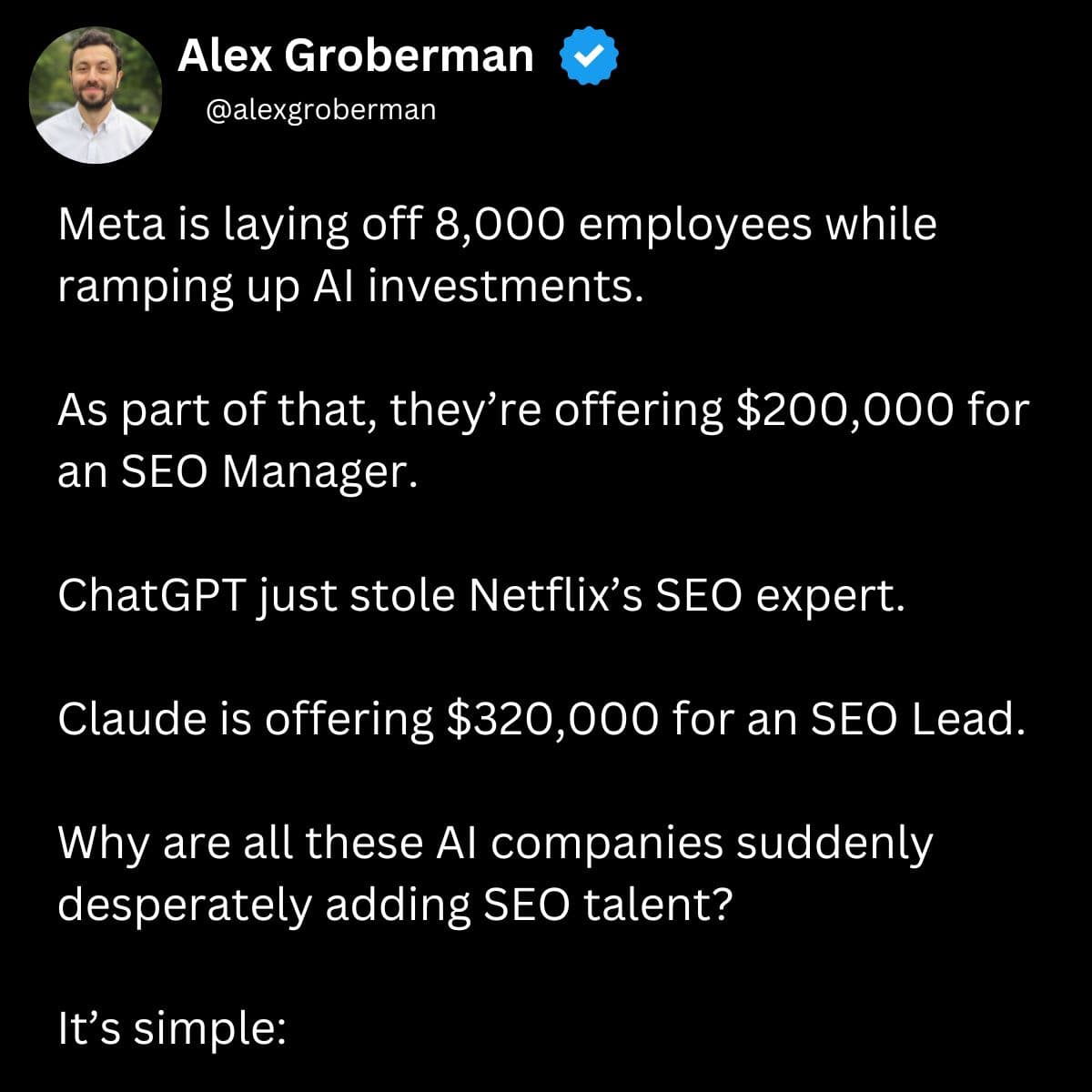
This aggressive restructuring by Meta, announced on April 24, 2026, aims to increase efficiency and redirect substantial capital towards its AI ambitions. The company, alongside other tech giants like Microsoft and Amazon, is pouring billions into AI infrastructure, compute, and specialized talent, even as it reduces its overall headcount, according to KSL News. The strategic moves highlight a growing industry trend: streamlining traditional operations to fund AI-driven growth.
Why Are AI Companies Prioritizing SEO Talent?
The sudden demand for high-level SEO expertise within leading AI firms stems from a fundamental change in how information is discovered and valued. Public markets are now evaluating companies not solely on revenue, but also on their "AI leverage." This leverage is split between internal operational efficiency and external visibility within AI-driven search environments.
AI models from ChatGPT, Gemini, and Perplexity are becoming the initial touchpoints for users seeking information, bypassing traditional search results and company homepages. Questions like "What is the best social media platform for advertising?" are now answered by AI overviews, eliminating the need for a click. This means that if a brand's content is not "structured for extraction, comparison, and citation" by these AI systems, it simply won't appear in the answers.
How Does AI-Mediated Discovery Change Valuations?
The shift towards AI-mediated discovery means that the primary unit of trust is evolving from clicks on a website to direct citation by an AI. Companies that adapt are building what many are calling "invisible moats"—a strategic advantage where their brand becomes the default, trusted source within AI answers. This isn't about traditional search rankings; it's about being the foundational data that AI models rely on.
For instance, WPTA reports that Meta's layoffs are part of a broader strategy to use AI tools to "automate tasks that once required large teams." However, the parallel hiring of SEO talent indicates an equally vital external focus. Brands that successfully structure their content for AI systems—emphasizing commercial intent clusters, best-in-category pages, and clear product positioning—are seeing disproportionate revenue capture. This success, in turn, directly influences market valuations. Analysts expect valuation multiples in 2026 to quietly shift towards companies that master this AI-mediated discovery.
The implications for businesses are significant. Companies that fail to optimize their content for AI extraction risk having their traffic fragmented across various AI interfaces, losing visibility and potential revenue. As one commentator aptly puts it:
SEO isn’t dying — it’s evolving into AI visibility. The real game is becoming the source AI trusts, not just ranking on Google. Those who adapt will own the demand curve.This new frontier of AI Search Optimization ensures that external visibility is as critical as internal efficiency for tech giants in the AI era.
— Ghalib Mustafa, Industry Commentator